
Sales and Marketing Alignment
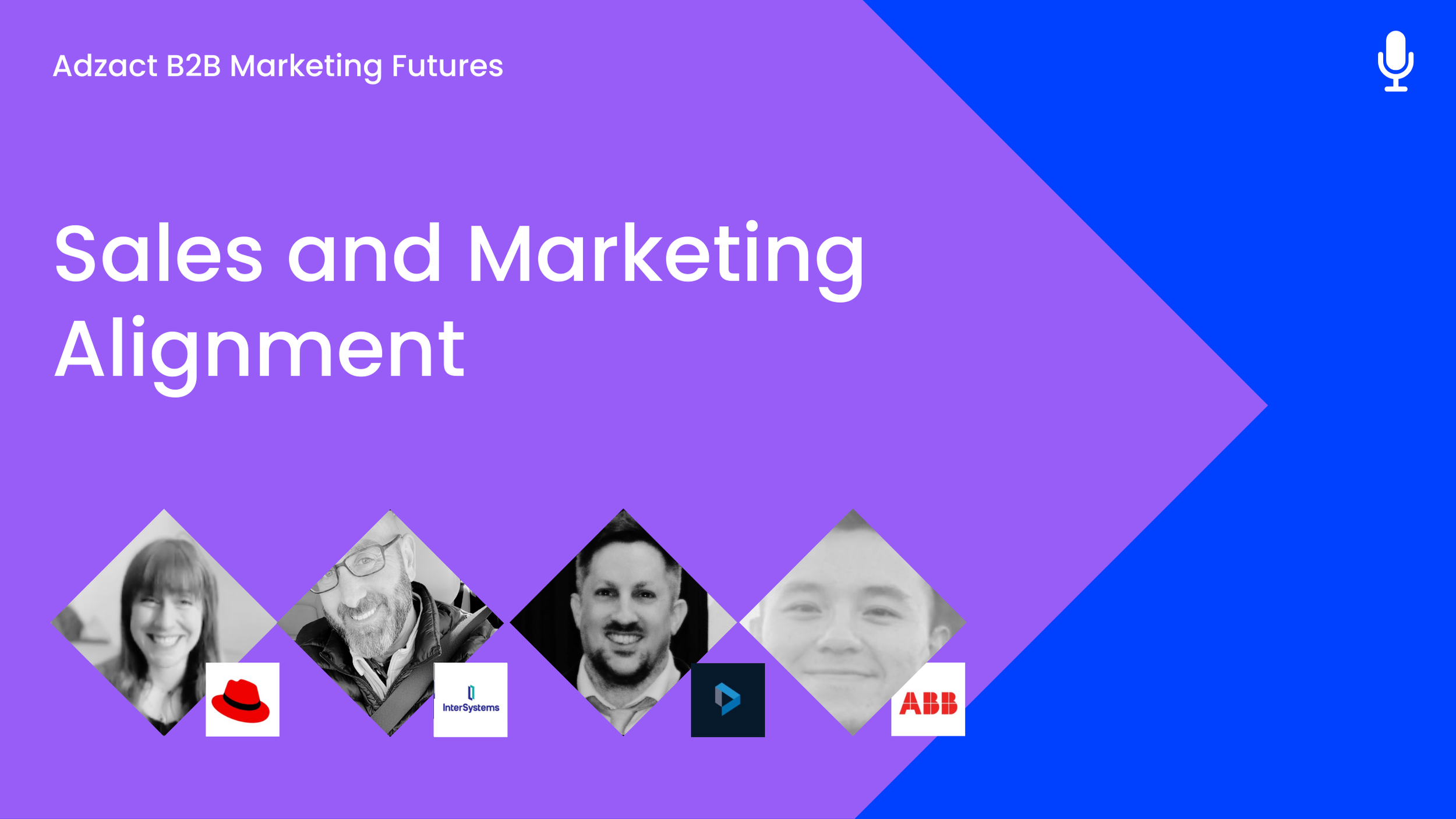
Sales and marketing alignment remains one of the most talked-about goals in B2B and one of the hardest to achieve in practice.
In this episode of B2B Marketing Futures, senior marketing leaders come together to explore where sales and marketing alignment breaks down today, and what practical frameworks, rituals, and processes actually help teams work as one.
This episode delivers a candid, practitioner-led view of how sales and marketing can move beyond friction to shared outcomes, clearer accountability, and stronger commercial impact.
Guests
Kelli McCabe, Sr. Account Based Marketing Manager at Red Hat
Gary Maggiolino, Senior Manager, Global Marketing Technology at InterSystems
Paul Brienza, Former Growth Marketing Manager at Lloyd’s List Intelligence
Evan Ang, Global Digital Marketing Manager at ABB
Transcript
Joaquin Dominguez (00:00)
welcome to another episode of B2B Marketing Futures. Today we are talking about sales and marketing alignment, a topic everyone agrees is important, but many teams still struggle to get it right. Even with better tools and more data, alignment often breaks down around ownership, timing and expectations. In this episode, we will talk honestly about where things go wrong.
what has actually worked and what needs to change to make alignment stick. I'm joined by a great panel of experts working across IBM, demand generation, sales, and global teams. And before we start, I would love for each of you to briefly introduce yourselves and share a bit about your background. ⁓ Paul, would you like to start?
paul_brienza2k4 (00:42)
My
name is Paul Brienza, so I'm a Growth Marketing Manager. I've worked in a couple of demand generation based roles now where I've been responsible for delivering big integrated campaigns aligned with the strategic priorities of the business to generate new business opportunities.
⁓ and sort of leveraging the tech stack to enable sort of better sales and marketing alignment. Yeah, that's me.
Joaquin Dominguez (01:14)
Awesome. Thank you so much, Evan.
Evan Ang (01:16)
Thanks for having me. So I'm Evan Ang and I have over a decade of B2B digital marketing experience working across international team. So currently I'm leading the digital marketing team for one of the divisions at ABB. And ABB is a multinational company with leading technologies in electrification and automation and helping all industries to be more productive and to be more sustainable.
Joaquin Dominguez (01:38)
Awesome. Thank you so much. Welcome. Kelly, welcome.
Kelli McCabe (01:42)
Hi, so I lead account-based marketing with a focus on experience design. I work closely with sales to turn human insights into intentional moments to build trust and move real pipeline. ⁓ I currently work at Red Hat and I've been doing account-based marketing since before it was even really a thing back in the day. ⁓
Joaquin Dominguez (02:00)
Amazing. Thank you so much. And finally, Gary. Welcome, Gary. Welcome again to our podcast.
Gary Maggiolino (02:04)
Thank you.
Thank you. I'm glad to be back. I lead global marketing operations here at InterSystems. We're a data management analytics and integration company. Over the course of my many, many, many years, I've done everything from top of funnel lead generation to sales and marketing alignment to field strategy, kind of the whole pipeline gamut. So I'm happy to be here.
Joaquin Dominguez (02:28)
Thank you for those great introductions. And you work in very different environments, which makes this a great starting point. Let's begin with where things tend to go wrong. Where do you sales and marketing alignment breaking down most often?
paul_brienza2k4 (02:29)
you
I think for me, data gaps, so inconsistent or misleading information being pushed into this into the CRM platform. it
basically confuses the sales team if they haven't got the right information in front of them or if there are any data gaps and the data is not relevant or complete, that's going to lead to higher disqualification and rejection rates. So I'm probably jumping ahead here, but the thing to do is obviously enable your tech stack to ⁓ integrate marketing and sales. So for instance, if you're a marketing automation platform that syncs with the CRM system. So as an example, Salesforce I've used and Eloqua.
It's about ensuring the sinker's working, it's about ensuring that the right information is being passed through to sales so that they can essentially self-serve so that they can go into the lead record. They know exactly how the lead has been generated, what touch points the contacts interacted with, which campaign it's been attributed to. You need to ensure completeness of data, you want to tell them where the data's been sourced because that's sometimes an obstacle. Sometimes if you're being cold called you're going to ask where did you get my data from.
Yeah, well, all of those things basically need to come together so that the sales team have got full visibility of where the leads are coming from. if you've got data gaps, that can lead to a breakdown between sales and marketing, and it can lead to a breakdown of trust as well between sales and marketing. So if you're sending poor quality leads to sales, they're just going to stop following them up, or they're not going to prioritize them, and then they'll go cold. When you want to have strict SLAs, you want to ensure leads are being followed up probably within day of them being generated.
I'd say data gaps is a big one for me.
Joaquin Dominguez (04:11)
Interesting. What about the rest?
Evan Ang (04:13)
Yeah, probably I can chime in on this
point as well, because in my area of work, mean, lead management process is really one of the common challenges. And I think the main point is the definition of lead. What is a good lead? What type of data we are collecting to identify, you know, it's a good lead that our sales team can follow up on. And usually this is a great area, must say, because depending on what we are trying to achieve, marketing will have one idea and sales will have the other idea. And we need to build
paul_brienza2k4 (04:34)
.
Evan Ang (04:40)
a common customer profile in order for us to target the right audience, to make sure we generate the right content, to engage with them so that we can get good high quality leads that the sales will want to follow up.
paul_brienza2k4 (04:52)
Yeah, and I'd expand on that. So I'd say from my end, isn't confusion around the sort of what a lead means like MQL, sales team know that if it's MQL, means it's come from marketing, it's a lead. Like for us, we've got two different statuses, one which is lead, which means that they need to be nurtured further and they wouldn't actually be rooted to the sales team anyway. If it's an MQL, it will be rooted to the sales team. So there's kind of no...
ambiguity, they know it's a lead generated by marketing, they know they need to follow it up. Where the confusion is, is how best to approach that leads. So they need to understand what level of intent has gone into creating that lead. So we have a differentiation between fast track leads and nurtured or scored leads. So if it's a scored or nurtured lead, it means they've come through a lead nurture program built on a lead score model. And the lead score model basically captures buying signals and determines at what point they're ready to become a lead, but they haven't actually specifically requested.
any contact from sales. Whereas if they're a fast track lead, they may have filled out a website form, for instance, and they have actually requested contact from sales. So what you need to make sure is that the sales team are crystal clear on the definition or the differentiation, should I say, between those two. Because what I've found is that sometimes salespeople are going into a nurtured lead and they're treating it as a fast track lead and they assume
that they've requested contact themselves when actually they haven't. And as soon as they get on the phone and someone says to them, no, actually I haven't asked for a demo, they then put the phone down and they get disqualified when actually they need to be worked a bit more because they have actually shown quite a lot of interaction across their life cycle. you should be able to see that in the lead record. So yeah.
Joaquin Dominguez (06:31)
Really interesting. about the rest? Where do you see the breaking down the sales and marketing alignment?
Gary Maggiolino (06:38)
I agree with all of those points and they're massive common problems. I see alignment as, to put it as, it's a stool. You have four legs of the stool. You have communication, collaboration, technology, and then you have process. And you need all of those working hand in hand or else,
stool is going to be wobbly and you're falling over. For me, what I have historically seen, not just in our organization, but in other organizations that I've worked with and partnered with, it's the process. A lot of times there's disagreement on process or workflows. And to Paul's point, you think something's a nurture lead and maybe a fast track, or you think something's one way or the other and they're jumping in and they're grabbing them when they should be focused elsewhere.
paul_brienza2k4 (07:12)
you
Gary Maggiolino (07:25)
If you have that type of process of workflow misalignment, it breaks down all the other pieces of the puzzle.
Kelli McCabe (07:32)
I feel like we're all saying the same things in different ways. I'd say like, at least my opinion would be kind of, it comes down to translation. You know, we're all having the same business outcomes and goals, but we measure things differently and say things differently when it comes to sales and marketing. So while, you know, sales might come to us and say like, I just closed a $6 million opportunity and that's great.
paul_brienza2k4 (07:34)
Yeah.
Kelli McCabe (07:56)
It comes down to who was the context that engaged with that? Did our content actually influence that? We're looking at it more from a forensic lens and sales is looking at like, we won, this is great. And we're looking at it like, okay, we won, but what went into that? How do we replicate it or further expand upon it? So, it's all kind of the same, but yeah.
Joaquin Dominguez (08:17)
I'm...
Gary Maggiolino (08:18)
is an always on fight. Where did it source? What was the last touch? What was the first touch? I want this as part of my ROI puzzle for my event. You want to just say it was sales prospect.
paul_brienza2k4 (08:30)
It's easier if I've been pulled from the same direction.
Kelli McCabe (08:30)
But think saying it's a fight is also part of the problem
because if we start to say it's a fight, then that's when you start to think of the sales and the marketing being in completely different camps. And that's part of the problem too.
Gary Maggiolino (08:33)
Yeah. Right, true.
paul_brienza2k4 (08:43)
Yeah, so actually.
Joaquin Dominguez (08:43)
And Kelly, ⁓
Kelly, before we continue, I'm curious to know in a one-to-one ABM context where the mistakes are more visible, where do things usually go wrong? Is it timing, sequencing or agreement on priorities? I don't know. Tell us about one example when things go wrong in one-to-one ABM. I think that would be...
Kelli McCabe (09:07)
Yeah, I think when
things go wrong is not having an understanding of like what ABM is, that it is a sales and marketing motion when there's that like misalignment there and there isn't that communication ongoing. I like to always say to my sales reps that like my door or Slack is always open sort of thing. But like a recent sort of example would be when an MDR was putting the wrong leads into the wrong sequence that I had built custom for a customer specifically. So he was putting like
from account A into account B sequence and basically account B was custom to a specific microsite that didn't even speak to account A. So it was just like a misunderstanding. He was getting in like a large amount of queue and you know completely understandable because he handles all of you know our larger industry based
cues for the leads that we acquire from a content perspective, from events, like all across the board. So for him at the end of the day, it was just like numbers. Like he just wanted to move people through like the sequence that was built.
paul_brienza2k4 (10:05)
So,
Kelli McCabe (10:07)
And what I ended up doing was just setting him down and walking him through like, here's the content that they, ⁓ you know, went through. Here's what they're actually being directed to. Like this is a very custom level sort of natured approach as opposed to just like.
paul_brienza2k4 (10:09)
Okay. .
Kelli McCabe (10:20)
you know, your kind of standard blanket outreach. Like you don't want to be sending the CEO of some sort of organization like, hey, did you talk to us recently? That sort of thing. You want to be sending them like, I saw you engage with us on XYZ. I actually have more information about that. Also, I saw that you like, you know, went to Ohio University. I did too. Like that sort of thing. You want to make it more custom. And I think that like miscommunication on ABM, but also like, you know, more of these, these white glove level.
sort of approaches that we're doing is where some of that misconnect can also happen.
paul_brienza2k4 (10:53)
So I've kind of worked for a couple of fairly large global organizations where you've got sales teams across the globe in different locations. so yeah, and that's not, and also there's quite a high staff chin in sales teams. Like, you know, people come and go quite, quite high degree of frequency.
So I take communication between marketing and sales and sort of the educational piece around where leads are coming from can be a challenge in that particular scenario. I mean, if you're working for a small SME, then it might be a bit easier, but certainly if you're in a large corporate and it's a global company and you're trying to reach out to people across the globe who work in different time zones.
That's why going back to what I said earlier, it's really important that you can get to a place where there are no data gaps and where salespeople can just self-serve and go into lead record and they know exactly how to approach that lead based on the information presented to them. Because it's pretty challenging otherwise to have have loads and loads of different meetings and one-to-ones and so on and so forth when you're working for a large corporate.
Joaquin Dominguez (11:48)
Yeah. And Evan, you also work for a large organization, global organization. Where does the misalignment show up most clearly between global and local teams or between sales and marketing?
Evan Ang (12:01)
That is a very good question. I think this alignment comes in different layers. So usually, let's say if you launch a campaign, we plan it globally and we have a global awareness campaign, for example. But then we get the most high level target audience and so on, just know which regions you're trying to focus on so that we can launch a global campaign. But eventually, we need to localize everything. And when it goes into a local level, you need to start aligning with the local teams.
paul_brienza2k4 (12:21)
Okay.
Evan Ang (12:29)
Because whatever you have created, like content, the messaging, on a global level, doesn't mean that you can just translate directly into a local language or just use the content directly. Sometimes you have to rethink, OK, how is the local audience different? What is the best way to reach them? What type of content, which format they will resonate most with? That's why there will be different levels of alignment that you need to work on. Yeah, and that's it.
paul_brienza2k4 (12:42)
Okay. Okay.
Kelli McCabe (12:54)
That's when you get creepy, like with ABM. Yeah.
Evan Ang (12:57)
Yeah.
Yeah. And I mean, like, this is something also very challenging in another way, because who are we aligning with? Because there are different types of roles within a sales team, right? That's the sales team manager versus the field sales. So, you know, you can be aligning with the sales team manager to create a campaign, for example, and we are generally thing-lit based on
some aligned definition of a good lead and so on. But when it comes to the reality, when the field service team are out looking, visiting customers and so on, do they have time to follow up all these leads? And maybe their definition of a good lead will be different because they already have a pool of leads they are actively following up with. So they will have even higher criteria to spend time to review all the leads that you have been generating for them. And so you must make sure that these are really high top tier, high quality leads that they should spend their time on.
paul_brienza2k4 (13:22)
Yeah.
Yeah, so for me, that's why it's important to create a middleman or woman. You want to have like build a strong alliance, maybe with like a regional sales leader, for instance, because they're kind of on the ground managing the sales reps day to day. So yeah, you like if you like you're in a global company as well. So you want to sort of build.
contacts across the regions and identify who the best person is to act as your middle person so that the messaging that you want to create for the sales team sort of trickles down to their teams.
Joaquin Dominguez (14:15)
Yeah, that's a great point. And Gary, you work with very long cell cycles with changing buying teams. Where does alignment tend to fall apart? Is it around data, signals, handovers?
Gary Maggiolino (14:21)
Yep. ⁓
Well, too, I think everyone kind of hinted at it, the the very differences between markets, especially when you go region to region, you know, we have we have customers in 98 countries, we have 12 marketing regions, 20 something sales regions all around the world. So every markets, every markets different, every sales cycle, you know, our big markets are federal government, financial services and health care, some of the most, you know, high risk, transaction rich
you know, risk averse industries. So the sales process is so unique to each industry and each region. from my perspective, where things start to fall apart is not just the communication, but the collaboration, you know, to Evan's point, you know, there needs to be, you know, a constant, there needs to be continuity rather.
around the regions that you're doing. working the same process. You're working the same materials. You know, there needs to be some kind of a smart marketing kind of collaboration that's ongoing that you're able to identify these things when they start to go sideways. So you can course correct very quickly because once they do, it can have ramifications across the globe.
Joaquin Dominguez (15:36)
Yeah, well, that's a great point. So.
Evan Ang (15:36)
And can I just add a point regarding
the different timeline? Because for us in marketing, we run marketing campaigns on a calendar timing. Like you do a two-month campaign, three-month campaign. Whereas the sales opportunities is very unpredictable. Sometimes it might take years just to close one opportunity So it might also end up that marketing tends to report based on engagement matrix more. Because there's
paul_brienza2k4 (15:52)
Yeah.
Evan Ang (16:02)
nothing we can really share in the time of our campaign because opportunities takes time to come in. That's why I think we probably a different approach is that we need to look at a more long-term approach when we are timing when we run a campaign so that we can see more holistically what is the return. And we have to probably not just executing a campaign but more like how do we keep on activating it, re-engaging the leads after some time because it's not like they will buy something tomorrow, it takes time.
So we need to have a longer timeline in terms of how we plan marketing campaigns.
paul_brienza2k4 (16:34)
You do need to make sure expectations are aligned because in my experience once you've generated the lead and it's become an opportunity, know some salespeople want you to continue reaching out to them but some say back office, you know, I want to do my own nurturing at this point.
Even if it takes 12 months, two years for them to become an opportunity, I've experienced instances where they don't want them to be nurtured by marketing anymore. I mean, if you keep bombarding them with emails, then it can obviously be a bit of a nuisance and could actually be detrimental to the sort of the chances of it actually converting to a customer. yeah, I think it's like I said, it's just about making sure your line of expectations are known what sales want. They might actually prefer you to leave them out of the campaign so that they can do their own nurturing when they've reached the opportunity stage.
Gary Maggiolino (17:13)
Yeah, to expand on what Paul said and actually what Kelly was mentioning around ABM motions. know, sometimes always on campaigns, nurture type campaigns, especially when you're in ABM type cadences can have a detrimental effect on an ABM motion. Like if you're kind of mid campaign and you've gotten some traction with them and you've moved from AI, you're over in the D and you think you're starting to get close to opportunistic state.
and then we're suddenly marketing starts nurturing them and saying, hey, have you heard of this product? Well, yeah, I've been engaged with sales for six months on it. Why are you sending, you know, it creates, some, some misfire.
paul_brienza2k4 (17:46)
Yeah.
Kelli McCabe (17:51)
think that's also where it helps to have that alignment and that constant communication and connection with one another. If they're going to a conference and then they're uploaded into Salesforce and they're not marked as do not contact and you've got your MDR reaching out ⁓ to someone that is in the middle of a deal, that could kill something. It almost happened once at our organization. So there's definitely a lot of ⁓ plug and play, but I also think kind of to all of our points about how this is a long-
It's not just like an instant sort of, quick fix kind of hit. Like you do have those instances, especially like in ABM or in some of the one-to-one engagements, but it is also a lot longer, six to eight month play. Like if you're running a custom event or a series or something to that effect, it doesn't mean that someone's going to enlist in an opportunity tomorrow. You have to follow them and, you know, continue engaging with them. And then...
paul_brienza2k4 (18:41)
Okay.
Kelli McCabe (18:44)
come to find maybe in a year, they will be a part of a different opportunity that wasn't
paul_brienza2k4 (18:46)
Okay.
Kelli McCabe (18:48)
forecasted in the original future. But that's just a great win to point to sales for.
Joaquin Dominguez (18:53)
Yeah, I think we've been talking about the importance of having processes in place, but alignment only matters if it helps cells perform better. So let's talk about the outcomes and how do you make sure marketing activity actually helps cells do their job?
paul_brienza2k4 (18:57)
Okay. Okay.
Gary Maggiolino (19:13)
You you I'll jump in first. You need shared goals. You need shared metrics. KPIs you need you know from a you know your leads X times this equals you know those type of metrics. So you have to have a clear, concise and collaborated. Set of measurements of goals. You know marketing is responsible for top of funnel and generating up through MQL.
paul_brienza2k4 (19:14)
. you
Gary Maggiolino (19:39)
Stales needs to do their piece
and the handoff needs to go. So they have to be shared and you both have to have a piece of the pie. There has to be a lot and very stringent and defined SLAs between them during the handoff process. Those are to me are the critical pieces.
paul_brienza2k4 (19:55)
Yeah, and I'd say because we don't always have unified goals, so marketing are often targeted on the number of leads they generate in sales. you're looking further down the funnel, they get targeted more on pipeline.
conversion. And because there's a misalignment of goals, I mean, we're going back to the first question now that can lead to one of the most common breakdowns between sales and marketing. Now, for me, I've been banging the drum constantly. And I think we are starting to shift towards a place where marketing are now getting targeted more for pipeline generation. And I think that kind of aligns more with how sales are measured.
I think if we can get to that place in general as a marketing industry, I think that particular challenge is going to be alleviated. Ideally, you want to be focusing more and to build trust with sales. You want to be focusing more on delivering quality leads rather than the quantity of leads. It does actually come from sales as well, especially from senior stakeholders, there's a lot of pressure on how many leads you'd
leads you generating, but I think if you can focus more on quality over quantity, and you're more likely to do that in the business, it's more likely to pull in that direction if the key KPI for marketing is, let's just say, ⁓ open pipeline, as an example, how much pipeline have you generated per campaign over the course of the year? Yeah, so to Gary's point, that would mean that your goals are aligned with sales and it's less likely to be that breakdown.
Kelli McCabe (21:18)
I'd also say, think it's also about education too. Like I don't know about you guys, but when I talk to sales and I say MQLs, I see eyes glaze over. So I think, you know, it's showing them what that actually means, like a lead versus a contact and really like creating that education path for them helps to resonate and also understand that like we're all working towards one goal, one team. Like we, again, we speak different languages, but we're really meaning the same things. So, yeah.
Joaquin Dominguez (21:45)
Yeah, but I totally get the value of pipeline and generating leads, but how do you tell when content or engagement is helping sales conversations rather than getting in their way?
paul_brienza2k4 (21:57)
you need to sort of create a sort of feedback loop. So you make sure that you've got like regular meeting cases with sales teams. And I was saying earlier, you know, try not to have so many meetings, try and, you know, allow sales reps to self-serve. But it's important to have a two-way conversation. It's important to understand from sales what's working and what's not and what content is resonating with the audiences. So yeah, you can do that by obviously creating a feedback loop. Make sure you can communicate to them via
Lots of businesses use Teams for instance, so you might have like group chats and that's an opportunity to kind of reach out to salespeople as well as having a regular meeting cadence, I'd say maybe bi-monthly for each regional sales team.
Evan Ang (22:34)
I think one thing we also have to recognize is that on the customer side, their buying behavior has changed as well. It's not just one lead and you get one order. Now they are becoming like a team of people who are evaluating. So from our perspective, what marketing can help is to engage with different type of potential leads, try to identify what's the structure like from a customer side, finding different entrance point so that we can sell into a company, for example. I think that's where the ABM come in. ⁓
But then definitely, think that requires alignment, trying to understand from sales what is the persona of the customers we are speaking to, what are the different type of messages, information that will be required. Because for example, an engineer versus a business developer versus an IT manager, might need different type of information, different type of messages to resonate with. And that's how we have to personalize.
paul_brienza2k4 (23:25)
.
Evan Ang (23:28)
everything that we are doing now in terms of content, messaging, and so on. And I think that's a topic that we have to transfer over to the sales team as well, because we are not going to do a broadcast type of marketing anymore. But what marketing can really help you is to reach out and engage with the different type of influencers, business decision-makers in the customer side that can help to close that opportunity.
Joaquin Dominguez (23:51)
being very clear, you create different campaigns for different personas and, or you map accounts and you need to ensure that you have touched all the decision makers that you map in that account before you move that to a certain stage. I don't know. do you, how do you guys plan around that?
paul_brienza2k4 (23:57)
you
Gary Maggiolino (24:11)
And maybe Kelly can speak better to this because of the ABM. know, it's in, to Evan's point, you know, understanding the buy groups and, know, traditionally, a lot of times it's extending your ICPs. Your ICPs are organizational levels, but you need to have a layer down that says, what are the personas of the various buying groups? You have people who are operational, people who are sales, people who are strategic, people who are product, people who are project.
paul_brienza2k4 (24:14)
Okay.
you
Gary Maggiolino (24:38)
you know, what are their needs, what are their, you know, so it becomes, so, and content plays a critical role in that. Cause if you're not messaging to those personas as they're going through the buyer journey, if you're not kind of laying that out and saying this person needs to get this at this time, you know, things can, can create just complete misalignment with what their organizational challenges are or what they're trying to evaluate.
paul_brienza2k4 (24:39)
Okay.
Kelli McCabe (24:59)
100 % for sure. And as Evan mentioned earlier, with the globalization versus localization, I think that also applies just in terms of ICPs as well. And I was thinking of some of our motions that we've done where I've taken global content and then streamed it down to my actual account. So that way it's more personalized on that nature and that level. But when it comes to ABM, we're doing full funnel motions with our ICPs. So whether it's top of funnel being the individuals that are
paul_brienza2k4 (25:15)
Okay. Okay.
Kelli McCabe (25:28)
somewhat aware or ⁓ need to be kind of nurtured down to that
lower level. It's across the board sort of marketing is how I like to phrase it because we're really targeting all the different areas, but they all have different ICPs and different buying needs. So ⁓ you have to custom the content to their journey and that's where sales is so pivotal because I always joke that we like to make things look pretty in marketing or make them look good.
paul_brienza2k4 (25:33)
Okay. Okay.
Kelli McCabe (25:55)
But if it's not resonating and it's not actually like hitting home with
the customer, it's a wasted effort. It's not helping our credibility. It's not helping them, you know, close these deals or move these sales. So ⁓ we really need their buy-in and their support because they're the ones hearing like these keywords, these things that we use that really do resonate and hone in for the marketing efforts. Like those come from sales because they're the boots on the ground, you know.
paul_brienza2k4 (26:01)
Yeah.
Yeah, I think it's important marketers not to get obsessed with audience volume. Don't get into the habit of like
building an audience segment and thinking, oh, I want to see 50,000 people because that's going to give me the best chance of generating some leads. That's obviously the mass marketing approach and it's not really going to work. need to, whatever campaign you're running, the messaging has to resonate with the audience that you're targeting. So, persona-led campaigns work because you've got different buyer personas within an account. yeah, an account.
The specific account might actually belong to two or three or four different campaigns, but you've got different sort of persona groups within those accounts that fit into those campaigns.
Gary Maggiolino (26:55)
I'd be interested if any of you are doing scoring on your content, effectiveness scoring or any type of matrix.
paul_brienza2k4 (27:02)
Yeah, I do. I've been using Eloqua in the past and yeah, the lead score model has been built into Eloqua and the way it's built is the folder structure and the way that you save your email files and your landing pages and so on. you basically have, you'll have a folder for awareness, you'll have a folder for consideration and you'll have a folder for decision. They're sort of generally
accepted as the three main stages of the funnel before they become the lead. And they get scored differently based off which piece of content they've engaged with and at what stage of the funnel. So they won't score as highly, for instance, if it's at the awareness stage, if they've downloaded a piece of content from an email that's saved in the awareness folder, they'll only score a few points, but then they'll score more if they're going to engage with content further down the funnel, where it's typically more product-centric content. That's where they're shown
sort of higher intent. So, you let's just say they've downloaded a couple of case studies in the last 14 days, you know, at that point, they're scoring quite highly and possibly ready to become a leader.
Joaquin Dominguez (28:05)
Well, great. We have covered what breaks, what helps. Let's zoom out for a moment. If you could fix one thing about how sales and marketing work together, what would it be?
Kelli McCabe (28:17)
In an ideal world, I'll just go ahead and say it. I wish we kind of all reported into the same sort of structure. I think us being in separate teams is really what is the dividing factor amongst us is like your boss is your boss, my boss is my boss, like that sort of thing. And again, having that different language and translation going back to the original question, I think that that's like what definitely is the harder part in having been.
paul_brienza2k4 (28:26)
Thank
Kelli McCabe (28:44)
a part of ABM for so long at this point before it became more on the mainstream where it is now. It was a lot of finger pointing back in the day, know, sales and marketing. We blamed each other marketing, you know, blaming sales for not doing follow up. It was very exhausting. And I think like the fix is like, let's, know, have empathy for each other. I say this all the time to other marketers who
aren't on the ABM side of things, but they always are asking like, why is sales always have like deadlines and they're always a fire drill? And like, we are also always have deadlines for them that are also always a fire drill and they help us out. honestly, if we could all just be part of the same team, that would be the dream for me, but.
paul_brienza2k4 (29:24)
Yeah.
Totally agree and it will remove the sort of misalignment of goals. So yeah, actually I'm repeating myself now probably, but I think the one thing I'd fix is for marketing to be targeted on pipeline and that for that to just be one team goal. So firstly, you're going to align with sales because you're kind of thinking more about the revenue that you generate and rather than the number of MQLs. I think it will mean that marketing will leverage their campaigns differently to focus more on
lead quality rather than lead quantity. I think it will eliminate the confusion around which channels perform best or any sort of arguments within the marketing team about, know, well I've contributed this lead, no I've contributed this lead, it's the event, no it's social media or whatever. Just have everyone pulling towards the same goal. Remove the issue around channel attribution. If you can just have one campaign incorporating all the different channels and...
stop worrying about channel attribution and who's performing the best, just all work towards the same goals and I think you're more likely to succeed as a team.
Joaquin Dominguez (30:18)
and why pipeline and not revenue?
because that could be the end goal. ⁓
paul_brienza2k4 (30:21)
I'd say yeah, for me personally pipeline,
I think there are too many uncontrollables at the point that they become pipeline. It might not convert to an opportunity and it might not, you you can't really hold marketing accountable for it. Because for instance, it might be because a competitor as a better product than you, or it might be because the pricing and packaging strategy is wrong. And I don't think marketing should be held accountable for that. That would probably go back to the product team.
Too many uncontrollables at the point that it's become an opportunity. think we should, I think marketing should be targeted on open pipeline only. And then after that, it's other sort of functions within the business that needs to pull together to ensure that you're seeing a high opportunity to conversion rate.
Joaquin Dominguez (31:02)
Yeah, in your ideal world, Kelly, of everyone being part of the same team, do you think you could align on revenue rather than pipeline with all the difficulties that Paul mentioned of aligning on revenue with too many things not under your control?
Kelli McCabe (31:19)
In iReadHow, definitely have, I'd say more more on that held to those standards, which is definitely a delight. But kind of going back to the first question in the translation part, I think it also comes with the education because they don't understand when they're closing a deal. They see $6 million or I'm using that as an example because that was recent because they're like, we did so well. But if you're not being held to the same metrics that they are in the same way, then
It's a win for them and that part of the team, but it's not a win for the whole team. So we all need to be on the same page. But yeah, I feel like that mean girl scene or something like where it's like in an ideal world. I would love for us to be like one team, one dream.
paul_brienza2k4 (32:01)
you
Joaquin Dominguez (32:01)
Yeah.
Evan Ang (32:02)
Just maybe just to add, I think I can just echo what Paul and Kelly has mentioned. And I think besides having a shared goal, there should also be clear ownership if we are a team who's responsible for different part of the process, like from lead generation to lead handover and so on. It should be clear what everyone is doing. And I think even within the marketing team itself, depending on how big the team, what different.
paul_brienza2k4 (32:10)
. Okay.
Evan Ang (32:26)
functions you have, because for example, I come from digital marketing, it's like function
within a function. whenever we plan like a campaign, a product launch, you involve different type of roles within marketing, you have digital marketing, you have content manager, you have product marketing, everybody plays a different role. And sometimes sales might be confused. What each of you are doing, because we come to a joint meeting with all the marketing functions together, I think we should be aligned.
as well, are clear, you know, having a good governance process, what we are actually doing so that we can give the right input and not confuse sales when they are trying to, you know, give us some idea about we keep on asking different questions that they might not understand what we are actually trying to achieve. So I think if we can clear, you know, come up with clear ownership process, you know, within the team, regarding the whole process, how we work with each other, I think that will definitely help sales to understand better how marketing works and how marketing is supporting them.
Joaquin Dominguez (33:18)
All right. Thank you so much for all those insights.
This has been a great conversation. We covered a lot of the things about alignment, not just the theory. Thank you so much, Kelly, Gary, Paul, and Ivan for sharing your experience. thank you for all the ones listening to B2B Marketing Futures.